Sinking Ship experiment Results

  • 487 Replies
  • 150666 Views
*

sandokhan

  • Flat Earth Sultan
  • Flat Earth Scientist
  • 7272
  • +7/-41
Re: Sinking Ship experiment Results
« Reply #360 on: June 09, 2009, 03:56:50 AM »
And now, dyno let me pull out all stops.

We will increase the distance to 55 kilometers, Hamilton - Toronto lakeshore west condominiums.

At that distance, there would be a 59 meter curvature, with an visual obstacle of 195 meters, given the position taken by the photographers right there on the beach (2 meters altitude).

http://www.flickr.com/photos/planetrick/487755017/

Looking from the beach in Hamilton across Lake Ontario towards Toronto


http://www.flickr.com/photos/planetrick/487726854/in/photostream/

Looking Across Lake Ontario at Toronto from Lake Ontario Beach in Hamilton
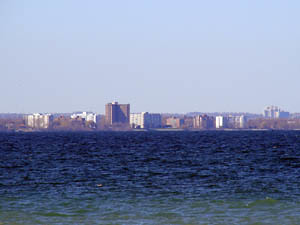


No curvature whatsoever, where there should have been 59 meters of it, given the 55 km distance, pictures taken right on the Hamilton Beach.


?

dyno

  • 562
  • +0/-0
Re: Sinking Ship experiment Results
« Reply #361 on: June 09, 2009, 04:38:59 AM »
edited OP to include distance(18km)

My rebuttal.

The images you linked do not have information about them. At least 2 images are shot from elevations significantly greater than 2m. It doesn't matter in any case. All images linked are from approximately the same position yet show significantly different portions of the skyline. Atmospheric effects can account for this.

None of the accounts provide any measure of detail from which to infer ground level distortion.

The last 2 images do not contain a shoreline or any means of inferring elevation of the shooting point. Without this information, talk is merely speculation.

No magnification is evident in any image and I see no restoring of anything either.

If you present images taken which document the conditions under which they were shot then we can debate.

No refutation on my images?

*

sandokhan

  • Flat Earth Sultan
  • Flat Earth Scientist
  • 7272
  • +7/-41
Re: Sinking Ship experiment Results
« Reply #362 on: June 09, 2009, 04:55:34 AM »
You are really dynodumb.

Your claimed 18 km distance must be verified by official data from that ship, that is why I never use but a fixed visual target. What is the written proof of your distance? Did you call the captain of that ship to ask where he was located? How do you estimate the 18 km distance, with proof?

My images have all the information needed posted right next to them.

All were taken on the beach, by that author j-a-x, that is why I posted the other two photos, so you can see where you are.

In the first one, you can see the rocks located right next to the St. Catharines beach, and right next to Lake Ontario, look carefully.

The Toronto lakeshore west condominiums are seen clearly with all the details needed, do not play dynodumb with me, because it is going to hurt badly, my friend.

Do you understand what is going on here?

THERE SHOULD BE 59 METERS OF CURVATURE BETWEEN THE TWO SHORES.

FROM THE BEACH IN HAMILTON YOU CANNOT SEE ANYTHING UNDER 195 METERS, WAY ABOVE THE HEIGHT OF THOSE CONDOMINIUMS.

YOU DO NOT NEED MAGNIFICATION, CUT THE CRAP.


?

dyno

  • 562
  • +0/-0
Re: Sinking Ship experiment Results
« Reply #363 on: June 09, 2009, 05:22:49 AM »
Actually if you read the OP, I identify Rottnest Island as being 18km away and state the distance to the ships is unknown. I'm pretty sure the island doesn't move around much.

Sure you can see the rocks. Both the foreground rocks and horizon are in focus which means he could have been any height.

I restate that the shots that show the condos have nothing to indicate elevation.

Why can't refraction account for this?

2 images from the same place(St Catherines) with differ greatly in detail shown. Evidently favourable atmospheric conditions produce a superior mirage.

Magnification is vital especially since you are proposing your links favour Rowbowtham. You haven't provided any evidence in favour of that nonsense and still haven't addressed why my findings refute his.

*

sandokhan

  • Flat Earth Sultan
  • Flat Earth Scientist
  • 7272
  • +7/-41
Re: Sinking Ship experiment Results
« Reply #364 on: June 09, 2009, 05:31:43 AM »
Your approach does not work with me dyno.

We will increase the distance to 55 kilometers, Hamilton - Toronto lakeshore west condominiums.

At that distance, there would be a 59 meter curvature, with an visual obstacle of 195 meters, given the position taken by the photographers right there on the beach (2 meters altitude).

http://www.flickr.com/photos/planetrick/487755017/

Looking from the beach in Hamilton across Lake Ontario towards Toronto


http://www.flickr.com/photos/planetrick/487726854/in/photostream/

Looking Across Lake Ontario at Toronto from Lake Ontario Beach in Hamilton


No curvature whatsoever, where there should have been 59 meters of it, given the 55 km distance, pictures taken right on the Hamilton Beach.

The authors of the photos right there on the beach, we do not need no magnification.

All the evidence is right here in the pictures dyno, do not pretend or play dumb, won't work with me.

Do you understand dyno?

The pictures were taken right on the Hamilton beach, so says the caption.

Those rocks there have about 1 meter in height, you have to be right there on the beach, to see those details, but I suppose you would like to increase the height to about 20 meters, wouldn't you?
No way Dyno, not with me here...

Your target does not specify the distance to the ships, that is what I am trying to tell you. The photos with the ships are worth nothing without a distance being offered, with proof.

As for the 18 km, you simply DID NOT USE A GOOD QUALITY CAMERA TO CAPTURE THE FULL DETAILS.


?

dyno

  • 562
  • +0/-0
Re: Sinking Ship experiment Results
« Reply #365 on: June 09, 2009, 05:57:28 AM »
What is your objection with my choice of camera?
The 6.1MP CCD is a quality device. No lens was used in the telescopic images due to the direct mount. What further details were you expecting?

Cables and handrails are resolved in the images of the ships. I think I was pretty much at the limit here due to atmospheric distortion.

There is no more details to the ships between the non-telescopic image and the telescoped one at the same elevation. Increasing elevation reveals more hull. Distance doesn't matter.
But if you want distances, explain the island.

Tell you what, contact the photographer and ask him for a full size high resolution version of those images and ask him exactly where he was standing. Then we will have something to work with.
I do believe it's stange that more isn't obscured but like I said, it depends exactly where the image was shot.

?

NTheGreat

  • 1019
  • +0/-0
Re: Sinking Ship experiment Results
« Reply #366 on: June 09, 2009, 06:10:28 AM »
A small observation about the CN tower images. In This image There is only a small section of lake that you can see above the breakwater, no thicker than the breakwater itself. In This image however, the visible lake is many times thicker than the breakwater at the bottom. This suggests the second image was taken at a higher altitude than the first.

*

sandokhan

  • Flat Earth Sultan
  • Flat Earth Scientist
  • 7272
  • +7/-41
Re: Sinking Ship experiment Results
« Reply #367 on: June 09, 2009, 06:26:06 AM »
Let me show you what quality equipment is.

http://www.scribd.com/doc/9979943/Dove-Dover (the original photos posted on flickr.com, I saved the web pages)


Taken on the Cap Gris Nez beach, 34 km distance, the full view of the White Cliffs Dover.

Here are the photographers on the French beach, Shipspotting:


That is the equipment you should have used, dyno.


Let us now visit Beamer Falls Conservation Area.

http://www.flickr.com/photos/libraryplayground/343037881/

Beamer?s Falls #071114
River Forty Mile Creek
Class Ramp
Size Medium
Height: 45
Crest: 20
The Niagara Peninsula Conservation Authority acquired Beamer Memorial Conservation Area in 1964, to protect and preserve the Niagara Escarpment and the Forty-Mile Creek valley system. The site is home to a variety of Carolinian plants and wildlife.

One of the best proofs that there is no curvature over lake Ontario; from 45 meters, we need another 10 meters just to reach the top of the curvature, right in front of you, and then miss the bottom 65 meters of the buildings in Toronto (the visual obstacle). But there is no curvature, no midpoint 55 meter obstacle, the Toronto downtown buildings visible top to bottom.

http://www.flickr.com/photos/suckamc/53037827/


No 55 meter curvature whatsoever.

?

NTheGreat

  • 1019
  • +0/-0
Re: Sinking Ship experiment Results
« Reply #368 on: June 09, 2009, 06:53:15 AM »
Quote
Taken on the Cap Gris Nez beach, 34 km distance, the full view of the White Cliffs Dover.

I can't see anything that suggests the image was taken from the beach of Cap Gris Nez, especially considering Cap Gris Nez consists of a rocky outcrop over 30 meters high.


Quote
Let us now visit Beamer Falls Conservation Area.

The area's a good 120 meters above the surface of the lake.

*

sandokhan

  • Flat Earth Sultan
  • Flat Earth Scientist
  • 7272
  • +7/-41
Re: Sinking Ship experiment Results
« Reply #369 on: June 09, 2009, 06:59:42 AM »
NGreat, do not try these things with me here; I will punish you.

HERE IS THE BEAMER FALLS CONSERVATION AREA:


45 meters, NOT THE 220 METERS HEIGHT YOU ARE SUGGESTING; THERE AIN'T NO SUCH THING IN GRIMSBY, NOT SOME MILES AWAY FROM THE SHORELINE, AND THEN WE WOULD NOT BE IN GRIMSBY AT ALL. Not even at 2 km inland, the height of the Escarpment does not reach beyond 170 meters.

Did you think it would work with me? Not a chance...

Even with a 120 meter altitude, we can see the entirety of the view from Toronto, impossible even from that height (which does not exist there).

THE CAPTION OF THE PHOTOGRAPH SAYS: TAKEN FROM BEAMER FALLS CONSERVATION AREA, 45 METERS IN HEIGHT, THAT IS WHY I POSTED THE GEOLOGICAL FACTS.

You wrote:

I can't see anything that suggests the image was taken from the beach of Cap Gris Nez, especially considering Cap Gris Nez consists of a rocky outcrop over 30 meters high.

Cap Gris Nez has a maximum height of 45 meters.

Here are the photographers on the BEACH ITSELF:

http://gal.neogen.ro/galleries/socialro/68/ca/072b29eb_0020000203086_00_600.jpg

IT SAYS SHIPSPOTTING.

THE NEXT PHOTOGRAPH IS THIS, THE SHIPSPOTTING, LOOK AT THE ORIGINAL WEB SITE ADDRESS:

http://gal.neogen.ro/galleries/socialro/68/ca/072b89d5_0020000203085_00_600.jpg

One, right next after the other; no curvature whatsoever.

?

NTheGreat

  • 1019
  • +0/-0
Re: Sinking Ship experiment Results
« Reply #370 on: June 09, 2009, 07:19:04 AM »
Quote
<photo of Grimsby>

LOTS OF YELLING

I'm not sure what you're saying. The photo of Grimsby probably was taken from the Escarpment. I can't see anything suggesting that the photo of Toronto was taken from the same place. All the caption says is 'As seen from Beamer Falls Conservation Area', nothing about the Escarpment.


Quote
Here are the photographers on the BEACH ITSELF:

Why is the large cliff behind them highlighted? I can't see anything that suggests that that is the exact place from which they took the photos, and besides, it hardly looks like they are right down by the water's edge there.

*

sandokhan

  • Flat Earth Sultan
  • Flat Earth Scientist
  • 7272
  • +7/-41
Re: Sinking Ship experiment Results
« Reply #371 on: June 09, 2009, 07:30:55 AM »
That highlight is the Cap BLANC Nez cliffs, about 10 km in the distance.

The Escarpment includes cliffs ranging from 20 meters to 45 meters at the Beamer Falls Conservation Area. In the city of Grimsby there is at most 45 meters to take into account.

If you want to go further inland, about 2 km, you will ascend to a 170 meter height. To see those details, you need to ascend to 237 meters, inland, or to 200 meters in Grimsby, no such point of reference there.


KillaB, go ahead, make my day.

http://www.stevefu.net/hostedstuff/mine/Caturday/fucktard.JPG

?

NTheGreat

  • 1019
  • +0/-0
Re: Sinking Ship experiment Results
« Reply #372 on: June 09, 2009, 08:05:04 AM »
Quote
To see those details, you need to ascend to 237 meters, inland, or to 200 meters in Grimsby, no such point of reference there.

How high is this hill of water again?

?

dyno

  • 562
  • +0/-0
Re: Sinking Ship experiment Results
« Reply #373 on: June 09, 2009, 05:53:36 PM »
Let me show you what quality equipment is.

http://www.scribd.com/doc/9979943/Dove-Dover (the original photos posted on flickr.com, I saved the web pages)


Taken on the Cap Gris Nez beach, 34 km distance, the full view of the White Cliffs Dover.

Here are the photographers on the French beach, Shipspotting:


That is the equipment you should have used, dyno.


Let us now visit Beamer Falls Conservation Area.

http://www.flickr.com/photos/libraryplayground/343037881/

Beamer?s Falls #071114
River Forty Mile Creek
Class Ramp
Size Medium
Height: 45
Crest: 20
The Niagara Peninsula Conservation Authority acquired Beamer Memorial Conservation Area in 1964, to protect and preserve the Niagara Escarpment and the Forty-Mile Creek valley system. The site is home to a variety of Carolinian plants and wildlife.

One of the best proofs that there is no curvature over lake Ontario; from 45 meters, we need another 10 meters just to reach the top of the curvature, right in front of you, and then miss the bottom 65 meters of the buildings in Toronto (the visual obstacle). But there is no curvature, no midpoint 55 meter obstacle, the Toronto downtown buildings visible top to bottom.

http://www.flickr.com/photos/suckamc/53037827/


No 55 meter curvature whatsoever.

OK, you need to research material you intend to debate. There is nothing in those images to indicate their equipment was better. If anything it shows an inferior smaller telescope and no information is provided about the camera used to take the shots. The shots weren't taken on the beach, they were taken from a great elevation. The resolved detail is far less than any shot I took.

So once again, your explanation of my images?

*

sandokhan

  • Flat Earth Sultan
  • Flat Earth Scientist
  • 7272
  • +7/-41
Re: Sinking Ship experiment Results
« Reply #374 on: June 12, 2009, 05:20:00 AM »
Quote
To see those details, you need to ascend to 237 meters, inland, or to 200 meters in Grimsby, no such point of reference there.

How high is this hill of water again?

The curvature between Grimsby and Toronto is 55 meters. In order to see the following details from Grimsby, you would have to ascend to 200 meters there in that city, no such geographical point references exists, at most 45-50 meters...


Each and every detail of the opposing shore being seen...

Here is a zoom:


A zoom from the same spot at night:


Each and every detail being seen, no curvature whatsoever over a distance of 53 km.

The original photos:

http://www.weatherandsky.com/Mirages/Toronto1.jpg
http://www.weatherandsky.com/Mirages/Toronto2.jpg

http://www.flickr.com/photos/tundrabluephotography/312939439/

Another photo from Grimsby, zero curvature:


dyno, over a 18 km distance we will have a 6.3 meter curvature, if we take that into account, your photos do not need anymore comments...use a better photographic equipment, and you will capture the full details, even from 1 meter of height...

?

dyno

  • 562
  • +0/-0
Re: Sinking Ship experiment Results
« Reply #375 on: June 12, 2009, 06:20:57 AM »
what is better photographic equipment? tell me what it is and why it is better than what i used.

do you even know?


?

NTheGreat

  • 1019
  • +0/-0
Re: Sinking Ship experiment Results
« Reply #376 on: June 12, 2009, 08:07:00 AM »
Quote
The curvature between Grimsby and Toronto is 55 meters. In order to see the following details from Grimsby, you would have to ascend to 200 meters there in that city, no such geographical point references exists, at most 45-50 meters...

Suppose you were to just ascend to 120 meters. How high would the hill of water appear to be from there?

?

dyno

  • 562
  • +0/-0
Re: Sinking Ship experiment Results
« Reply #377 on: June 15, 2009, 05:13:06 AM »
still waiting.

?

dyno

  • 562
  • +0/-0
Re: Sinking Ship experiment Results
« Reply #378 on: June 17, 2009, 04:49:28 PM »
Your calculations were too quick; you should see nothing under 5.56 meters. In the zoom taken at nighttime we can see EVERYTHING, even the light from the small island in front of Toronto; and in the original (without zoom) photo in daytime, we can see every detail with no curvature whatsoever. 170 meters is a height which we will find 2 km inland, in Grimsby, the actual place the photographs were taken, we can ascend just to about 45 meters.

If you still have doubts, let me remove them right now:

Port Credit - Toronto, 14.5 km, 4 meters curvature, absolutely nonexistent, there isn't one centimeter/one inch of curvature over this distance:


Let us increase the distance to 33.6 km, zero curvature (supposed to be 22 meters), Oakville - Toronto:


There are the tops of trees visible in the large telescoped photos and a lack of shoreline. They are shot from a substantial elevation and therefore irrelevant to the discussion.

The other photos from the marina are more useful. While still lacking information about the equipment set up,  it does appear that the image was shot from tripod height.  You can't say there isn't any curvature though. The detail is insufficient to determine that. This was the whole reason I shot using a high magnification telescope and the unmagnified camera lens. What elevation are the buildings on the shore? Obviously nothing is built at water level to prevent flooding. Foundations etc all tend to lift things a little.

Besides levee, you still haven't shown up the problems with my images for which equipment information is known. That's the challenge. Open to anyone. Come on down.

?

dyno

  • 562
  • +0/-0
Re: Sinking Ship experiment Results
« Reply #379 on: July 01, 2009, 06:29:39 AM »
Paging Dogplatter.
Can you comment on the results in the OP?

*

James

  • Flat Earther
  • The Elder Ones
  • 5613
  • +1/-0
Re: Sinking Ship experiment Results
« Reply #380 on: July 01, 2009, 09:03:35 AM »
For starters, the change in visibility looks very pronounced for just 4 metres, regardless of RE or FE. I'm not saying it's wrong, but that did take me by surprise.

Anyway, looking at your pictures, I don't see why there is any difference with what would be predicted by a combination of natural perspective and the gradient of atmolayeric density which varies by altitude. It is not disputed that the bottoms of large objects will be obscured before their tops, because air is less transparent closer to the Earth (this is especially true over bodies of water, wherein spray and water vapour become additional factors). It is not disputed that one will be able to see a greater distance from a higher vantage point, again because the line of vision will pass through a greater area of atmolayer with better transparency. The effect seems more pronounced for the opposite shore than for the tanker, as one would expect given the greater distance involved.

I have given my opinion on the photographic evidence you have provided. I commend you for having the zetetic spirit to gather it for yourself.

To corroborate my interpretation, chiefly by demonstrating that the effects you have witnessed are highly dependent on variable conditions of atmolayeric distortion (if they were caused by curvature, they would be universally observed), I offer the following pieces of photographic evidence which clearly demonstrate a LACK of these effects, which we can only assume is caused by lesser atmolayeric distortion on the days and at the sites when and where these were taken:

http://theflatearthsociety.net/forum/index.php?topic=1090.0
http://theflatearthsociety.net/forum/index.php?topic=831.0
http://theflatearthsociety.net/forum/index.php?topic=607.0

Now, in the last item in that list, my esteemed colleague has even posted a highly detailed analysis of the distances, as well as a trigonometric proof that what we are seeing is none other than a Flat Earth vista (i.e., that curvature is completely absent).

My response to you, then, is this. Flat Earth Theory plausibly explains both sets of photographs. Not only does it predict the effect witnessed in yours (which is merely indicative of lower atmolayeric clarity), but of course it is wholly attested and corroborated by photographs taken in superior conditions which alleviate this phenomenon.

I am interested to hear if your globularism can explain both sets of photographs to the same satisfactory level. I am inclined to believe that it can't. It copes with your set of images just fine, since the phenomena of gradiated atmolayeric distortion and natural perspective (the latter hasn't really been an issue here given the distances involved) can be construed as evidence of phantom curvature by the dedicated globularist. Now, how does your theory cope with the second set of images?
"For your own sake, as well as for that of our beloved country, be bold and firm against error and evil of every kind." - David Wardlaw Scott, Terra Firma 1901

?

cdenley

  • 296
  • +0/-0
Re: Sinking Ship experiment Results
« Reply #381 on: July 01, 2009, 09:50:36 AM »
If the atmosphere were causing the bottom of the ship or the coast to be obstructed, then it would be gradually obstructed by what would look like fog, not obstructed by a horizon of water up to a specific point. The horizon of water obstructing the objects more at a lower elevation than a higher elevation cannot be explained by atmospheric visibility or perspective.

Now, for your photographic rebuttal, you should post the photos one at a time with the elevation of the photographer, the distance from what is not being obstructed by the horizon, and the geographic location. Make sure to include the source of the photo and data.

*

James

  • Flat Earther
  • The Elder Ones
  • 5613
  • +1/-0
Re: Sinking Ship experiment Results
« Reply #382 on: July 01, 2009, 10:52:52 AM »
If the atmosphere were causing the bottom of the ship or the coast to be obstructed, then it would be gradually obstructed by what would look like fog, not obstructed by a horizon of water up to a specific point. The horizon of water obstructing the objects more at a lower elevation than a higher elevation cannot be explained by atmospheric visibility or perspective.

There is no sharp cut-off point, if you closely observe the horizon you'll see that it's blurred because of this gradient effect, and that actually the visible bottom part of each object is generally slightly less clear than the top of it.

Now, for your photographic rebuttal, you should post the photos one at a time with the elevation of the photographer, the distance from what is not being obstructed by the horizon, and the geographic location. Make sure to include the source of the photo and data.

They're all posted in those threads, along with details, I see no reason to clog up this one by copying and pasting them all.
"For your own sake, as well as for that of our beloved country, be bold and firm against error and evil of every kind." - David Wardlaw Scott, Terra Firma 1901

?

cdenley

  • 296
  • +0/-0
Re: Sinking Ship experiment Results
« Reply #383 on: July 01, 2009, 11:35:16 AM »
There is no sharp cut-off point, if you closely observe the horizon you'll see that it's blurred because of this gradient effect, and that actually the visible bottom part of each object is generally slightly less clear than the top of it.

Are you actually suggesting the area in the red box is atmosphere?

Here I pointed out the very distinct point at which the horizon, not the atmosphere, no longer obstructs the image. Whether the atmosphere slightly affects the visibility above this point is irrelevant.


They're all posted in those threads, along with details, I see no reason to clog up this one by copying and pasting them all.
Some have details, some don't. Some are missing crucial details. Some make false assumptions. I'm not going to spam either thread by posting a grocery list of problems, nor do I want to waste my time, so why don't you find which photos provide sufficient and reliable data, then post it here.

?

dyno

  • 562
  • +0/-0
Re: Sinking Ship experiment Results
« Reply #384 on: July 02, 2009, 04:14:55 AM »
I believe that many of those shots of Toronto seem like compelling evidence for a FE were it not for the lack of resolution. You just can't tell if the shoreline is hidden or not. Are we actually seeing the land behind it?
The main city near me, Perth, is built on a river. The buildings are all elevated by 4-6metres above the water line. It doesn't really look that way though from a distance.

The images I have posted show quite clearly a distinct water line with resolvable objects like huts and houses behind them.

?

dyno

  • 562
  • +0/-0
Re: Sinking Ship experiment Results
« Reply #385 on: July 02, 2009, 04:18:05 AM »
see

this is the same as

from a different angle
« Last Edit: July 02, 2009, 04:19:57 AM by dyno »

?

cdenley

  • 296
  • +0/-0
Re: Sinking Ship experiment Results
« Reply #386 on: July 02, 2009, 06:51:40 AM »
Most of those photos were not taken for the purpose of FET evidence, and the elevation was not documented. Photos taken from Hamilton Beach could have been taken from a significant altitude. There is an observation tower on the beach. Photos taken from Grimsby could have been taken at altitude higher than 200 meters from Vinemount Ridge. The elevation is crucial, as well as details as demonstrated by dyno, and of course distance. Please provide the specific photos you think are valid evidence that there is obstruction on the horizon where RET would expect one.

?

Squat

Re: Sinking Ship experiment Results
« Reply #387 on: July 02, 2009, 07:55:47 AM »
I need your help everyone, especially the Feers.

I live here, 36.773672? N  28.246684? E for those that have/use google earth:


The arrow is pointing to a short, low jetty.

Ten miles away is an island, it's almost due east. Ten minutes walk will take me down to the small jetty where I could take photographs of the island from a standing position and from about 2 feet above sea level; I haven't measured the height of the jetty above sea level yet but it is quite low and I wouldn't dream of going to take any photos without taking a rule. I can probably get lower, to just above the surface of the sea but not so that I screw my camera lol.

I can provide you with details of the camera (an Olympus C-5000 Zoom) and set up and the data on each photograph will be readily available. I can take photos with normal exposure and with the zoom activated (3x optical and up to 10x digital zoom). I am not a photographer and the camera is nothing special  although I can change things like exposure time etc.

Now what do I need help with. Well, basically what do I need to do to allow those looking at any pictures to believe that I have taken them from the position I have indicated and what sort of settings should I use. Basically, you set the parameters and I'll take some snaps. I'm going to take some anyway as I am interested in what will come out. I will wait for a day when the humidity is such that the island is clearly visible and I will take the photos in the evening when the sun is behind me. So, do you want some photos from the eastern Med or are you happy to stick with (and argue over)Toronto.

I really don't know how I can put into the picture enough foreground detail to show that I am actually on the jetty and at what height. Maybe you guys can help there. Thanks

*

markjo

  • Content Nazi
  • 45124
  • +90/-134
Re: Sinking Ship experiment Results
« Reply #388 on: July 02, 2009, 11:04:54 AM »
I'm not sure about others, but I don't think that a small point and shoot camera will be up to the task.  Even at 5 MP, you still have a tiny CCD and questionable optics (some point and shoots use plastic lenses).  Personally, I'd prefer a good DSLR with a good quality lens, but I understand if you don't have access to such equipment.
Science is what happens when preconception meets verification.
Quote from: Robosteve
Besides, perhaps FET is a conspiracy too.
Quote from: bullhorn
It is just the way it is, you understanding it doesn't concern me.

?

Squat

Re: Sinking Ship experiment Results
« Reply #389 on: July 02, 2009, 11:34:08 AM »
I'm not sure about others, but I don't think that a small point and shoot camera will be up to the task.  Even at 5 MP, you still have a tiny CCD and questionable optics (some point and shoots use plastic lenses).  Personally, I'd prefer a good DSLR with a good quality lens, but I understand if you don't have access to such equipment.

I understand your concerns. I'll ask around to see what better equipment is available.

Thanks.