Fictitious Forces

  • 184 Replies
  • 89429 Views
*

Jack

  • Administrator
  • 5180
  • +2/-6
Fictitious Forces
« on: November 22, 2007, 11:13:28 PM »
FICTITIOUS FORCES
The Manifestations of Inertia


To minimize the number of threads and posts concerning about these forces, I've decided to make a little guide on why are they considered "fictitious". More details will be added in the near future.

A Brief Introduction


When we were young, we were taught that the force of gravity is what causes things to fall. As we get older, we began to know that this force is universal, that all celestial objects in the universe exert it to maintain orbit around other objects. We were told that this force is one of the four fundamental forces and its range is infinite. We were explained by our instructors that this force causes attraction behind masses, and the Cavendish Experiment "sort" of prove this phenomenon.

Yet...

The physical world is governed by two types of frames: inertial ("resisting") and non-inertial ("accelerating").  Fictitious forces (kinematic forces, pseudo-forces, inertial forces, etc) arise in non-inertial reference frames. In other words, an accelerating observer would notice a force exerted on him because his motion is changing. However, relative to a resting observer, the accelerating observer is undergoing inertia. Based on Newton's first law of motion, we can conclude that fictitious forces arise when a non-inertial observer adopts an inertial frame of reference.

Let's conduct a very simple thought experiment based on the equivalence principle. For example, a free-falling observer notices he is accelerating relative to the environment. Of course, he thinks the force of gravity is causing him to accelerate. However, this is false if we put him inside a free-falling elevator. In such elevator, objects "float" alongside the observer, drifting at constant velocity: the observer fails to recognize whether he is "floating" (at rest in mid-air), traveling at constant velocity, or accelerating. This is an inertial frame of reference, where an object's motion changes only when a force is applied. If the elevator accelerates up, he would most certainly touch the elevator. In his frame of reference, he would notice himself accelerating toward the elevator. Indeed, no forces are applied in this scenario.

Newton's three laws of motion and his laws of gravity dictate only in inertial frames; his laws are invalid in non-inertial frames. This is where Albert Einstein comes into the fray. He proposed that "gravity and acceleration are indistinguishable", meaning that the effects of gravity are the same compare to the effects of acceleration. He discovered that there is no fundamental difference between the force of gravity we felt in our lives and the fictitious forces felt by an accelerating observer: a resting observer at the Earth surface would feel the same way a resting observer would feel in a closed rocket accelerating at 9.8m/s2, far away from any sources of gravity. In other words, the force of gravity we perceive on Earth is basically the result of we undergoing an upward proper acceleration in our frame. Hence, Einstein created the equivalence principle.

Quote from: Wikipedia - Equivalence Principle

Equivalence principle:

Gravitational force = proper acceleration
Gravitational force = inertial force
Gravitational mass = inertial mass
Free falling = inertial motion

GRAVITATIONAL FORCES PROPORTIONAL TO INERTIAL MASSES ARISE WHEN A NON-INERTIAL OBSERVER ADOPTS AN INERTIAL FRAME OF REFERENCE.

To address these fictitious forces in a more correct and accurate way, we will examine them one by one.


Gravity

(Before reading, please note the distinction between gravitation and gravity.)

Gravity is said to be a force of attraction between two masses. The Earth exerts this force, which explains why all objects tend to fall when dropped from a specific height. Based on Newton's first law of motion, this force explains why free-falling objects accelerate. Unfortunately, gravity does not exist. For example, a free-falling observer would recognize a force exerted on him, causing him to fall. Relative to a resting observer, the free-falling observer is moving at constant velocity toward the ground. This is because both him and the free-falling observer are inertial.  Relative to a non-inertial observer, however, the free-falling observer is accelerating. Thus, since the force of gravity does not exist, we can conclude that the surface of the Earth is accelerating upward: the accelerating surface exerts an upward force to any person standing on it, thereby transforming his/her frame of reference from inertial to non-inertial. What we feel as "gravity" is actually proper acceleration.

Another example would be a ball inside a wagon. When the wagon is pulled, it enters a non-inertial frame of reference. The ball ends up at the back of the wagon. Why? In the ball's frame of reference, the ball "experiences" a force pushing it back. Relative to a stationary observer, however, the ball tries to stay in the same position right before the pull. A driver in an accelerating car is a similar example. When the car accelerates, the driver notices a force exerted on him, pushing him back to the seat. Relative to a stationary observer, no force is exerted on the driver: the driver tries to maintain a velocity of 0 while the car is accelerating. This is known as inertia. Same thing happens when the car stops: the driver moves toward the dashboard because he is trying to maintain his previous velocity while the car stops. The driver in this scenario experiences no force, as seen by a stationary observer.

The cart and the ball are at rest.
Quote from: Inertial observer

The cart moves, while the ball tries to maintain at rest.
Quote from: Inertial observer


Centrifugal force

Centrifugal force is a fictitious force felt by an accelerating (non-inertial) observer in a circular motion. In other words, this force arises in a non-inertial frame of reference. This is also known as the outward force, since it pushes the observer outward in a circular path.

There is no such thing as a "centrifugal force". The main reason is that the observer goes in a straight line while the car turns. Therefore, when the car turns, he moves outward. If the car has no doors, an inertial observer above would see the driver ejecting out of it in a straight line.

Quote from: Inertial observer

Imagine if a ball is swirling in a frictionless circular track constantly for more than 24 hours. Now, cut off a section of the track and see what happens: the ball goes off and rolls in a straight line.

The ball constantly swirls around the track.
Quote from: Inertial observer

The ball goes off the track in a straight line.
Quote from: Inertial observer

Here is a simulation of what happens to the tape when the car turns.
Quote from: Centrifugal force


The upper diagram is the point of view of an inertial observer. The lower diagram is the point of view of a non-inertial observer.
Despite the fact that the car is turning, the path traveled by the tape remains straight. In other words, the tape travels in a straight line while the car turns. Without windows, the tape will eventually flung out of the car in a straight path. This is what causes people to feel as if there is a force trying to "push" them out the car.

Hence, "centrifugal force" does not exist; it is just the sensation everyone feels while in a circular motion. Our head always go straight even if the car is turning.


Coriolis Force

The Coriolis force is a fictitious force that arises in a rotating (non-inertial, accelerating) reference frame. This force causes the deflection of an object's path viewed by a rotating observer, which is known as the "Coriolis Effect". This force is used to explain why winds on Earth appear to deflect. When the Earth rotates, the path of the air parcel is deflected or changed: the rotating observer notices the changes. So, what causes the Coriolis force? Nothing, as there is nothing at work to cause the phenomenon.

Place a ball at the edge opposite to the rotating observer. As the Earth spins, the path of the ball changes. In the rotating (non-inertial) observer's frame of reference, he notices the ball's path is changing. Relative to a non-rotating (inertial) observer, however, the path of the ball is actually straight. The observer is rotating, so the ball's path appears to be curved. If the observers were to be placed in an inertial reference frame, the path of the ball would appear straight.

The path of the ball viewed by a non-rotating observer.
Quote from: Inertial observer

The path of the ball is curved as view by a rotating observer. However, from a non-rotating observer, the path of the ball would still appear straight.
Quote from: Inertial and non-inertial observers

Here is a simulation of the Coriolis effect.
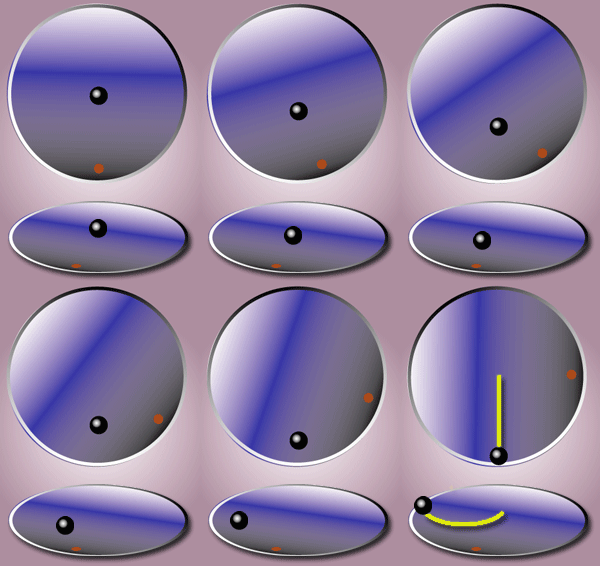
Quote from: Coriolis Effect

(The red dot is the observer.)
The upper animation shows a stationary (inertial) observer's point of view. The lower animation shows a non-inertial frame of reference, in which the observer is rotating, thus producing a deflection of the ball as seen by him. The plate is not "spinning" because the observer is rotating relative to it.


More forces to be added...

Quote from: Sources
http://www.batesville.k12.in.us/Physics/PhyNet/Mechanics/Newton1/AccRefFrame.html
http://en.wikipedia.org/wiki/Equivalence_principle
http://en.wikipedia.org/wiki/General_relativity
http://www.einstein-online.info/en/spotlights/equivalence_principle/index.html
http://www.black-holes.org/relativity6.html
http://id.mind.net/~zona/mstm/physics/mechanics/framesOfReference/nonInertialFrame.html
http://physics.gmu.edu/~joe/PHYS428/Topic7.pdf
http://www.shodor.org/metweb/session4/coriolis.html
http://www.writword.com/unituniv/c21.htm
« Last Edit: April 19, 2009, 09:49:50 PM by Jack »

*

Chris Spaghetti

  • Flat Earth Editor
  • 12631
  • +0/-4
Re: Fictitious Forces
« Reply #1 on: November 23, 2007, 03:23:00 AM »
my brain is melting. Sorry, please clarify the centrifugal force bit, what about when you hold a rope with a weight and spin around in a circle and can feel the rope pulling away from you?

*

Jack

  • Administrator
  • 5180
  • +2/-6
Re: Fictitious Forces
« Reply #2 on: November 23, 2007, 03:37:32 AM »
What happens if you let go of the rope?

?

SparteX

  • 411
  • +0/-0
Re: Fictitious Forces
« Reply #3 on: November 23, 2007, 04:49:33 AM »
I do believe you said gravitation exists but gravity doesn't. you've just said they're both the same thing.

?

eric bloedow

Re: Fictitious Forces
« Reply #4 on: November 23, 2007, 08:44:34 AM »
good explanation. but let me point out some things:
1) objects at high altitude weigh less that objects at sea level. (an easily establised fact)

the UA theory contradicts this! they should weigh the same!

refering to your car analogy: it's as if the passenger in the front seat and the passenger in the back experienced DIFFERENT amounts of accelleration at the same time!
therefore, gravity is real.

2) some FErs claim the earth does NOT spin! therefore there would be no coriolus affect on airplanes, etc!
3) hurricanes south of the equator spin in the OPPOSITE direction from those NORTH of the equator. this can ONLY be explained by a round earth's rotation and the coriolus affect!

Re: Fictitious Forces
« Reply #5 on: November 23, 2007, 09:06:19 AM »
im not really sure what youre trying to get at here as you didnt really prove anything...and if youre trying to prove that these forces have no effect on the physical world simply because they are termed 'fictitious' instead of 'non-inertial' in some physics textbooks then you are in serious need of some physics tutoring.

so you pointed out that the effects of gravitation and acceleration are indistinguishable from one another depending on your frame of reference - this is true.  however it doesnt address the fact that the earth would be accelerating AND exerting a gravitational pull - just because something accelerates doesnt mean that the force of gravity is replaced by that acceleration.  what it does mean is that there is now a non inertial force (or fictitious if you like that terminology better) acting in tandem with the gravitational force.  Hence a return to my previous statement - a body with the mass of the earth accelerating upward at 9.8m/s^2 would yield a net acceleration of 19.6m/s^2 near the surface which would appear to be fine and normal to the inhabitants who would see this as local gravity.

as for the coriolis force, no matter how fictitious you call it there is still a very real very observable effect on it's motion of objects in a rotating reference frame.  Like I said all you have to do is take any object traveling through the air a significant distance into consideration to know that it is very present.  unless of course the FE spins.  but so far my understanding is that it doesnt?

*

Jack

  • Administrator
  • 5180
  • +2/-6
Re: Fictitious Forces
« Reply #6 on: November 23, 2007, 09:49:37 AM »
im not really sure what youre trying to get at here as you didnt really prove anything
I'm curious, but what physics level are you in?

and if youre trying to prove that these forces have no effect on the physical world simply because they are termed 'fictitious' instead of 'non-inertial' in some physics textbooks then you are in serious need of some physics tutoring.
Right, they are non-inertial because they are fictitious forces which arise in a non-inertial frame of reference. However, they are actually inertial forces because they are proportional to inertial masses (F = ma). Gravitational force is also an inertial force, as gravitational mass equals to inertial mass. Or, simply, gravitational force = inertial force.

however it doesnt address the fact that the earth would be accelerating AND exerting a gravitational pull
So, what causes the gravitational pull/force?

- just because something accelerates doesnt mean that the force of gravity is replaced by that acceleration.
Refer to the equivalence principle.

  what it does mean is that there is now a non inertial force (or fictitious if you like that terminology better) acting in tandem with the gravitational force.
It is called a non-inertial force because it is a fictitious force that arises in a non-inertial frame of reference. An accelerating observer notices these "forces" exerting on him. To a stationary observer, however, nothing is exerted on the accelerating person.

Hence a return to my previous statement - a body with the mass of the earth accelerating upward at 9.8m/s^2 would yield a net acceleration of 19.6m/s^2 near the surface which would appear to be fine and normal to the inhabitants who would see this as local gravity.
Uh, the acceleration of the flat Earth is constant.

as for the coriolis force, no matter how fictitious you call it there is still a very real very observable effect on it's motion of objects in a rotating reference frame.
If you're standing on a rotating platform (non-inertial, rotating frame) and a ball is rolling towards you, what happens to the ball from your view? The path of the ball looks deflected. You, as the observer, are in a non-inertial reference frame.

By the way, what causes the Coriolis force?

Like I said all you have to do is take any object traveling through the air a significant distance into consideration to know that it is very present.  unless of course the FE spins.  but so far my understanding is that it doesnt?
Right, the air parcel travels in a straight line, but you're standing on a non-inertial frame (rotating Earth). Hence, the path of the air parcel appears curved
« Last Edit: November 23, 2007, 07:16:40 PM by Jack- »

*

Jack

  • Administrator
  • 5180
  • +2/-6
Re: Fictitious Forces
« Reply #7 on: November 23, 2007, 11:57:40 AM »
I do believe you said gravitation exists but gravity doesn't.
???

refering to your car analogy: it's as if the passenger in the front seat and the passenger in the back experienced DIFFERENT amounts of accelleration at the same time!
therefore, gravity is real.
Gravity is not real. It is fictitious. There's no force exerted on the driver and the passenger, as would be seen by a stationary observer relative to the ground.

2) some FErs claim the earth does NOT spin! therefore there would be no coriolus affect on airplanes, etc!
3) hurricanes south of the equator spin in the OPPOSITE direction from those NORTH of the equator. this can ONLY be explained by a round earth's rotation and the coriolus affect!

What causes the Coriolis force?
« Last Edit: November 20, 2008, 08:57:11 PM by Jack076 »

?

eric bloedow

Re: Fictitious Forces
« Reply #8 on: November 23, 2007, 01:07:39 PM »
once again you have misunderstood completely!

let me re-state: you claim "gravitation" is actually caused by the accelleration of the EARTH; the UA theory.

BUT if that was true, objects at sea level and objects on top of a mountain would weigh the SAME. because they would be accellerating at the SAME rate!

the FACT that the weight changes PROVES UA is wrong!
----------
the coriolus affect (NOT force!) is caused by the ROTATION of earth.
BUT the FE DOES NOT SPIN, so coriolus does not EXIST in the FE model!

the FACT that the corilus affect DOES exist in the ACTUAL world PROVES the earth IS spinning!

*

Jack

  • Administrator
  • 5180
  • +2/-6
Re: Fictitious Forces
« Reply #9 on: November 23, 2007, 01:14:40 PM »
let me re-state: you claim "gravitation" is actually caused by the accelleration of the EARTH; the UA theory.
Uh, no. I said gravitation can be considered acceleration. Gravitation is caused by the curvature of space-time.

BUT if that was true, objects at sea level and objects on top of a mountain would weigh the SAME. because they would be accellerating at the SAME rate!
No, never at the same rate. Ever heard of mass? Weight can be different.

the coriolus affect (NOT force!) is caused by the ROTATION of earth.
So, how does the rotation of the Earth causes the coriolis effect?

BUT the FE DOES NOT SPIN, so coriolus does not EXIST in the FE model!
Coriolis exists as a fictitious effect since it is caused by a fictitious force. It is perceived by an observer adopting a non-inertial (rotating) FoR.

the FACT that the corilus affect DOES exist in the ACTUAL world PROVES the earth IS spinning!
Coriolis effect arises in a non-inertial frame of reference. Please revise the FoR concepts.
« Last Edit: November 23, 2007, 01:56:49 PM by Jack- »

?

eric bloedow

Re: Fictitious Forces
« Reply #10 on: November 23, 2007, 02:37:21 PM »
ok, let me re-state my point:

we have 2 large objects: both the EXACT same weight, mass, EVERYTHING, verified by 2 identical scales (spring or electronic type, NOT ballance-type) sitting on the beach.

then one object and scale are moved to the top of the mountain.

NOW the one that moved weighs LESS than it did before! this is because the gravitation is exerting less force than before!

now, YOU tell ME why this happens.
----------
as for coriolus, if you don't think it works that way, what is YOUR explanation for the FACT that hurricanes spin the OPPOSITE way south of the equator?

*

Jack

  • Administrator
  • 5180
  • +2/-6
Re: Fictitious Forces
« Reply #11 on: November 23, 2007, 04:58:34 PM »
ok, let me re-state my point:

we have 2 large objects: both the EXACT same weight, mass, EVERYTHING, verified by 2 identical scales (spring or electronic type, NOT ballance-type) sitting on the beach.

then one object and scale are moved to the top of the mountain.

NOW the one that moved weighs LESS than it did before! this is because the gravitation is exerting less force than before!

now, YOU tell ME why this happens.
The higher objects have less proper acceleration, while objects at Earth's surface have a proper acceleration of g.


When I free-fall, I feel weightless. If the gravitational force is gone so easily, how could it be a force?

----------
as for coriolus, if you don't think it works that way, what is YOUR explanation for the FACT that hurricanes spin the OPPOSITE way south of the equator?
...Because the Earth rotates clockwise in the Southern Hemisphere. Hence, since we are standing on the Earth (non-inertial frame), air parcel deflects left as viewed.
« Last Edit: October 08, 2008, 11:15:11 AM by E.Jack »

?

eric bloedow

Re: Fictitious Forces
« Reply #12 on: November 23, 2007, 06:08:07 PM »
good, we agree, jack.

now what are the FE explanations?

*

Jack

  • Administrator
  • 5180
  • +2/-6
Re: Fictitious Forces
« Reply #13 on: November 23, 2007, 07:09:18 PM »
good, we agree, jack.
Yes, we finally agree that gravitational force does not exist, as there is only curvature of space-time which causes gravitation. We agree that the Coriolis force, which causes the Coriolis effect, is fictitious.

now what are the FE explanations?
Do this elsewhere.

?

cbarnett97

  • 2746
  • +0/-0
Re: Fictitious Forces
« Reply #14 on: November 23, 2007, 08:15:18 PM »
good, we agree, jack.
Yes, we finally agree that gravitational force does not exist, as there is only curvature of space-time which causes gravitation. We agree that the Coriolis force, which causes the Coriolis effect, is fictitious.
1) So we do agree gravitation exists on earth not the UA, glad that is settled.
2) the Coriolis effect is the result of a force created by the rotation of the earth Hence the "effect" in its title. it is nothing more that the observable result caused by the rotation of the earth
Only 2 things are infinite the universe and human stupidity, but I am not sure about the former.

*

Jack

  • Administrator
  • 5180
  • +2/-6
Re: Fictitious Forces
« Reply #15 on: November 23, 2007, 08:20:03 PM »
1) So we do agree gravitation exists on earth not the UA, glad that is settled.
Right, if you're talking about RE.

2) the Coriolis effect is the result of a force created by the rotation of the earth Hence the "effect" in its title. it is nothing more that the observable result caused by the rotation of the earth
So, how the rotation of the Earth causes the force? A force immediately jumps out if the Earth rotates, or if I rotate a disc?

?

cbarnett97

  • 2746
  • +0/-0
Re: Fictitious Forces
« Reply #16 on: November 23, 2007, 08:25:21 PM »
1) So we do agree gravitation exists on earth not the UA, glad that is settled.
Right, if you're talking about RE.
Exactly for the FE to be correct the earth can not have gravitation so if it does the earth can not be flat.
2) the Coriolis effect is the result of a force created by the rotation of the earth Hence the "effect" in its title. it is nothing more that the observable result caused by the rotation of the earth
So, how the rotation of the Earth causes the force? A force immediately jumps out if the Earth rotates, or if I rotate a disc?
[/quote]
Both will exert a force. but they will exert forces in different directions. Put a small ball on a plate and spin it and then see if what happens on the plate is close to what happens to us on earth.
Only 2 things are infinite the universe and human stupidity, but I am not sure about the former.

*

Jack

  • Administrator
  • 5180
  • +2/-6
Re: Fictitious Forces
« Reply #17 on: November 23, 2007, 11:32:29 PM »
Both will exert a force. but they will exert forces in different directions.
So, how do they exert the force?

Put a small ball on a plate and spin it and then see if what happens on the plate is close to what happens to us on earth.
Roll the ball and it will go in a straight line, assuming you're frame is inertial.

Now, if you're standing on the spinning plate, which means you're entering a non-inertial reference frame, what would you see of the ball?


Quote

The upper animation shows an inertial frame of reference, as seen by a stationary (inertial) observer. The lower animation shows a non-inertial frame of reference, in which the observer is rotating, thus producing a deflection of the ball as seen by him; although the plate is not spinning, this shows the perspective point of view of the rotating observer while the ball is rolling straight.
(The red dot is the observer.)

*

Gabe

  • 485
  • +0/-0
Re: Fictitious Forces
« Reply #18 on: November 25, 2007, 02:02:21 PM »
BUT if that was true, objects at sea level and objects on top of a mountain would weigh the SAME. because they would be accellerating at the SAME rate!
No, never at the same rate. Ever heard of mass? Weight can be different.
So, the UA doesn't supposedly accelerate things the same? So elephants seem to accelerate at different speeds than billiard balls?  ::)
Quote from: Tom Bishop
There is no evidence for an infinite Earth.
Quote from: Tom Bishop
The Earth is infinite.
Warning, you have just lowered your IQ by reading my sig.

*

Jack

  • Administrator
  • 5180
  • +2/-6
Re: Fictitious Forces
« Reply #19 on: November 25, 2007, 02:07:30 PM »
The UA accelerates constantly. However, the rate at which the Earth catches objects due to UA is different. Why? Non-conservative interactions (friction, air resistance, etc).

*

Gabe

  • 485
  • +0/-0
Re: Fictitious Forces
« Reply #20 on: November 25, 2007, 02:09:14 PM »
The UA accelerates constantly. However, the rate at which the Earth catches objects due to UA is different. Why? Non-conservative interactions (friction, air resistance, etc).

I agree with that. I'm talking about you talking about mass changing the rate at which they fall.
Quote from: Tom Bishop
There is no evidence for an infinite Earth.
Quote from: Tom Bishop
The Earth is infinite.
Warning, you have just lowered your IQ by reading my sig.

*

Jack

  • Administrator
  • 5180
  • +2/-6
Re: Fictitious Forces
« Reply #21 on: November 25, 2007, 02:10:58 PM »
The UA accelerates constantly. However, the rate at which the Earth catches objects due to UA is different. Why? Non-conservative interactions (friction, air resistance, etc).

I agree with that. I'm talking about you talking about mass changing the rate at which they fall.
When did I say that? I said weight is different due to mass.

*

Gabe

  • 485
  • +0/-0
Re: Fictitious Forces
« Reply #22 on: November 25, 2007, 02:21:50 PM »
Ah. Misread it twice. My bad.  :-[ ;D
Quote from: Tom Bishop
There is no evidence for an infinite Earth.
Quote from: Tom Bishop
The Earth is infinite.
Warning, you have just lowered your IQ by reading my sig.

?

Lorcan

  • 163
  • +0/-0
  • FE is nothing but an exercise in doublethink.
Re: Fictitious Forces
« Reply #23 on: December 03, 2007, 03:42:29 PM »
Good attempt at summarizing a semester of introductory college physics. This should be helpful for anyone who hasn't taken a physics course. Hopefully, this will be referenced (by both sides) before arguing the standard topics. While I don't notice any errors or problems initially, I'd like to urge you to clarify something that could potentially be misleading (and has repeatedly been used in a misleading way on this forum). In invoking the equivalence principle for gravitation and acceleration, you should clarify the (requisitely small) extent to which the equivalence principle applies. Apparently some think that this range is trivial, or even perhaps infinite. However, it is vital for the discussions to which many try to apply it that it be clarified that it is only locally true. Or just clarify that Gravitation = variable acceleration in general. This distinction is what most members of the board continue to overlook when trying to argue that an accelerating flat earth would have the same apparent gravitation effects that we see on the round earth. It's a huge mistake that is very easily corrected.

*

skeptical scientist

  • 1285
  • +1/-0
  • -2 Flamebait
Re: Fictitious Forces
« Reply #24 on: January 02, 2008, 12:13:01 PM »
Jack, your original post is clear and well-written. Hopefully people will find this helpful in their confusion about how the UA theory works, what coriolis effect is, and other questions.

I do, however, disagree with this statement:
Gravity is not real. It is fictitious. There's no force exerted on the driver and the passenger, as would be seen by a stationary observer relative to the ground.
The only difference between real and fictitious forces is that fictitious forces don't exist in "correct" reference frames, while real forces do exist in "correct" reference frames. So a force can either be real or fictitious depending on what reference frames you define as "correct". Apart from gravity, there is generally agreement over which forces are fictitious, but the question of whether gravity is a real force or a fictitious force is really a matter of convention, and not a question of physics. Just because someone prefers to use a different convention does not make them incorrect, as long as they agree on their predictions of the actual behavior of objects.

For some purposes it may be helpful to think of gravity as a real force, and work in frames of reference where freely falling objects are not considered inertial. For other purposes it may be useful to choose your inertial frames to be freely falling reference frames, and think of gravity as a fictitious force resulting from working in other frames of reference. As long as you are clear about what you are doing, there's nothing wrong with taking either or both points of view as the situation warrants.
« Last Edit: January 02, 2008, 12:16:10 PM by skeptical scientist »
-David
E pur si muove!

?

greoryg

Re: Fictitious Forces
« Reply #25 on: January 30, 2008, 10:17:43 PM »
Let's say that the earth is flat and does accelerate 9.8 m/s^2. This would mean that the earth's velocity is increasing by 9.8 m/s every second, which would mean the earth would reach, then break the speed of light in about a year. Using E=mc^2 (among other equations) you can see that the earth would have to gain an infinite amount of mass to reach the speed of light... in one year. Also, if the speed of light was reached and broken, then we would be traveling back in time... after one year. I hope you see where I'm going with this...

?

Bushido

Re: Fictitious Forces
« Reply #26 on: January 30, 2008, 10:21:09 PM »
Let's say that the earth is flat and does accelerate 9.8 m/s^2. This would mean that the earth's velocity is increasing by 9.8 m/s every second, which would mean the earth would reach, then break the speed of light in about a year. Using E=mc^2 (among other equations) you can see that the earth would have to gain an infinite amount of mass to reach the speed of light... in one year. Also, if the speed of light was reached and broken, then we would be traveling back in time... after one year. I hope you see where I'm going with this...

Leave the dead threads alone, you n00b. You're not the Messiah and this is not the second coming. Plus, your question has been covered in the FAQ.

*

Username

  • President of The Flat Earth Society
  • Administrator
  • 18223
  • +41/-73
  • Most Accurate Scientist Ever
Re: Fictitious Forces
« Reply #27 on: January 30, 2008, 10:43:59 PM »
Let's say that the earth is flat and does accelerate 9.8 m/s^2. This would mean that the earth's velocity is increasing by 9.8 m/s every second, which would mean the earth would reach, then break the speed of light in about a year. Using E=mc^2 (among other equations) you can see that the earth would have to gain an infinite amount of mass to reach the speed of light... in one year. Also, if the speed of light was reached and broken, then we would be traveling back in time... after one year. I hope you see where I'm going with this...
Which other equations are you using.
If you can't argue booth sides, yyou unnderstand neither

?

Bushido

Re: Fictitious Forces
« Reply #28 on: January 30, 2008, 10:44:54 PM »
c = a*t, obviously.  :D

?

Michamus

  • 44
  • +0/-0
  • I guess I've been wrong. The Earth is round...
Re: Fictitious Forces
« Reply #29 on: February 10, 2008, 03:04:08 PM »
It's gravitational field, and it represents the bending of space-time.

On a rubber sheet, put a mass at the center of it. The mass bends the sheet, creating a curvature. Hence, gravitation. Gravitational field represents that curvature. Now, if the mass is heavy enough, it will punch through the sheet. Thus, you get a hole (black hole).

I'm just curious... if matter does not attract other matter (which is required for a FE to be plausible) and gravity is not a "Force" (With it's near-zero aberration it would violate FTL limitations within SR) then why would this "rubber sheet" even bend? Is there some force pushing us all down onto this "rubber sheet" (acceleration)? If that is the case then why do we have stars and galaxies in all directions? Is there something attracting us below the "rubber sheet"? If so, then what? If there is not attraction, then the objects would simply rest on the perfectly flat surface of this "rubber sheet".